Palimpsest, n.
From the Greek palímpsêstos, “scraped again”: a parchment whose text was rubbed out so another could be written — and beneath which the older writing remains legible.
Before paper, writing cost an animal's hide. When parchment ran short, copyists would take a manuscript judged worthless, scrape off the ink with pumice stone, and write over it. But ink bites deep: beneath the new text, the old one survived — faded, sometimes upside down, never quite erased. It is that survival that made the word's fortune.
IWhat palimpsests have saved
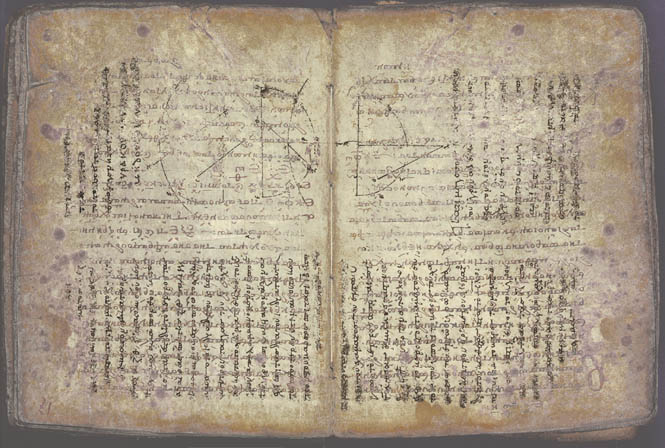
The most famous of them is the Archimedes Palimpsest. In the 10th century, a copyist in Constantinople transcribed several of Archimedes' treatises. In the 13th, a monk scraped those pages, folded them in half, and copied a prayer book over them. For seven centuries the euchologion circulated, prayed from, annotated — no one knew that it carried, lying beneath the lines, the only witness to The Method and the Stomachion, two texts of Archimedes lost everywhere else.
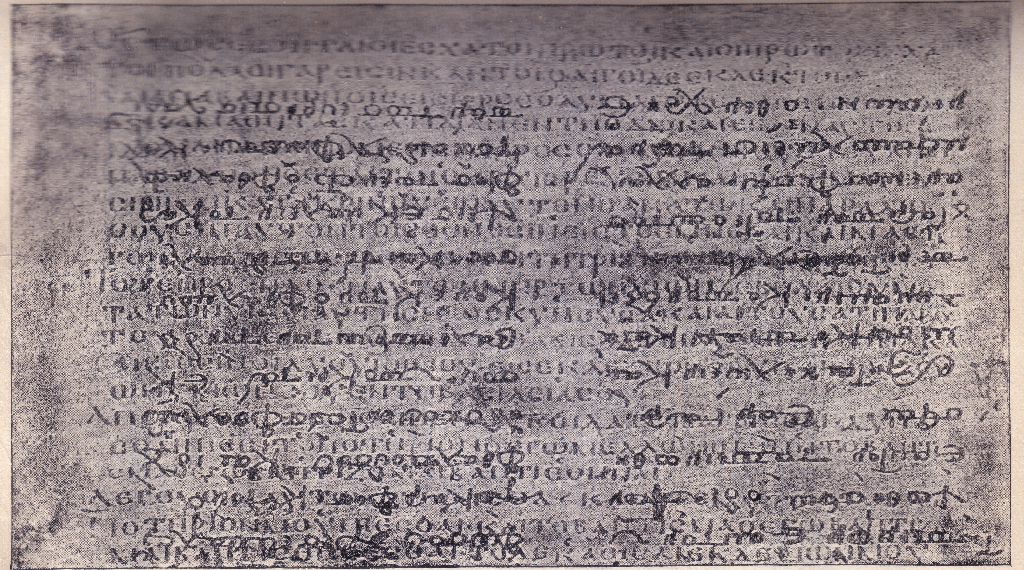
Another example, held at the Bibliothèque nationale de France: the Codex Ephraemi rescriptus, a 5th-century Greek Bible scraped in the 12th to receive the sermons of Ephrem the Syrian. Its name says it all — rescriptus, “written over”.
IIThe modern revelation
For centuries, palimpsests were read with the naked eye, or by reviving the ink with acid — at the cost of ruined pages. Today, multispectral imaging does what the eye cannot: photograph the same page at dozens of wavelengths, from ultraviolet to infrared, then combine the shots until the erased layer rises back into view. That is how the Archimedes Palimpsest was read again, word by word, between 1999 and 2008 — including beneath the illuminations added by a 20th-century forger.
Nothing that matters is ever lost. All it takes is an instrument that knows how to read it again.
IIIWhy our applications bear this name
A palimpsest is a document that keeps its layers. That is precisely what our three instruments work with:
- The Editor layers versions — drafts, snapshots, revisions — and marks the layer the AI wrote, legible in the file itself, years later.
- Pseudo writes a layer of false names over the real ones, for as long as a file is out travelling — then removes it. The original layer is never lost: that is the product's promise.
- Loupe reads beneath the damaged layer — a badly assembled video file lies about the order of its frames; Loupe reads what is actually recorded underneath, and rewrites the packaging without touching a single pixel.
One brand, one idea: what you entrust to our instruments remains legible, recoverable, yours.